
Redesigning How 800+ Global Companies Learn Workplace Inclusion
To turn a world-class research-backed content library into a structured learning system designed for scalable, adaptive delivery, and define its next generation of learning products.
Timeline
July 2024 to Jan 2025
Role
Learning Design and Product Innovation Consultant
*Core deliverables are confidential per contractor terms and available for discussion in interviews.
Business Goal
Catalyst Inc. serves 800+ member corporations with research-backed DEI content, but supporters were increasingly asking for something more: clear learning pathways, practical tools, and measurable outcomes they could demonstrate internally. Senior leadership recognized that translating a world-class content library into consistent, scalable learning experiences required a different kind of investment, and that emerging technology was creating both competitive pressure and new product possibilities the organization was not yet positioned to act on. The mandate was threefold: (1) build an adaptive learning system that guided learners at various maturity levels toward behavior change; (2) audit 100+ existing learning resources and create original content to make that system complete; (3) and conduct the research and product innovation work needed to define what Catalyst's learning experiences should become next.
Problem Statement
The organization had one of the most credible DEI content libraries in the field and no instructional architecture connecting it to how practitioners actually work. Content existed without sequencing. Topics existed without progression. Resources informed without enabling action. A new ERG (Employee Resource Group) leader had no starting point. An advanced DEI leader had no pathway deeper. There was no systematic way to identify which gaps required net new product development versus which could be closed by updating what already existed. Meanwhile, technology-forward competitors were entering the space with AI-integrated platforms and analytics tools, and differentiation on research quality alone was no longer enough.
Solution
Embedded within Catalyst's product and R&D team, working inside a full agile product development cycle alongside product management, content, research, events and marketing, and the digital team. Contributed to sprint planning, daily standups, and iterative ideation sessions, and executing multiple rounds of expert review.
Learner and user research. Conducted a qualitative research synthesis across 8 senior internal stakeholder interviews, 50+ supporter questions analyzed through Relationship Manager channels, and three internal research decks covering DEI trends, macro workforce trends, and direct supporter feedback. Delivered a written thematic analysis identifying learning journey topics of highest strategic value, sized by cross-source evidence, to directly inform sprint planning and R&D prioritization.
Instructional design and curriculum architecture. Designed 8+ learning journeys structured across 3 personas and 3 maturity levels, creating the underlying logic for personalized progression across the content library. For each journey, wrote and sequenced learning objectives from foundational to advanced, developed persona-aligned learner questions, and mapped 100+ existing Catalyst resources to questions. Applied a Learn/Say/Do outcome taxonomy across all content, revealing the library was heavily weighted toward knowledge and under-resourced in tools that enabled on-the-job action, a finding that shaped the content strategy downstream. The system was intended for future AI-enabled delivery, where users could enter through natural language queries and be routed to the most relevant starting point based on role, context, and experience. My work defined the structure and logic required for that personalization layer to function at scale.
Content development. Co-developed original content with AI assistance to fill small and medium gaps across all topic areas, delivering all materials in flat file formats to the digital team's technical specifications. Documented large gaps as formal R&D submissions via Asana's product innovation intake process, directly shaping the FY2025 agenda.
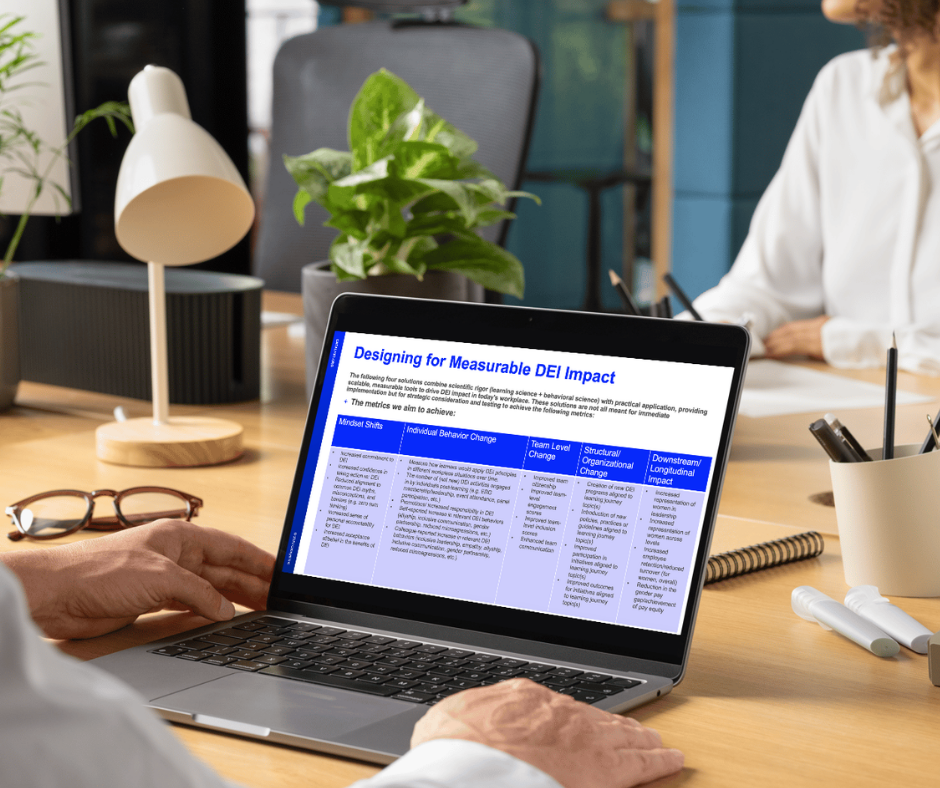
AI and emerging technology innovation. Delivered a concept pitch deck of 4 product concepts designed for supporter concept testing and validation. Each concept was fully specified with a problem statement, proposed solution, risks and opportunities analysis, functionality, features, user experience design, and an example use case. The four concepts were: immersive VR simulations with AI-adaptive scenarios that evolve based on learner choices; an AI chatbot integrated into Teams and Slack providing real-time DEI coaching, microlearning nudges, and escalation protocols; a more sophisticated AI agent capable of scanning internal communications, survey data, and engagement metrics to proactively surface DEI strategy recommendations with HRIS and platform integration; and digital learning kits and short-form video content designed for team-based and flow-of-work learning.